
AI Beyond Frames’ PEEK-A-BOO
When the Dark Knows Your Name
October 31, 2025
Article
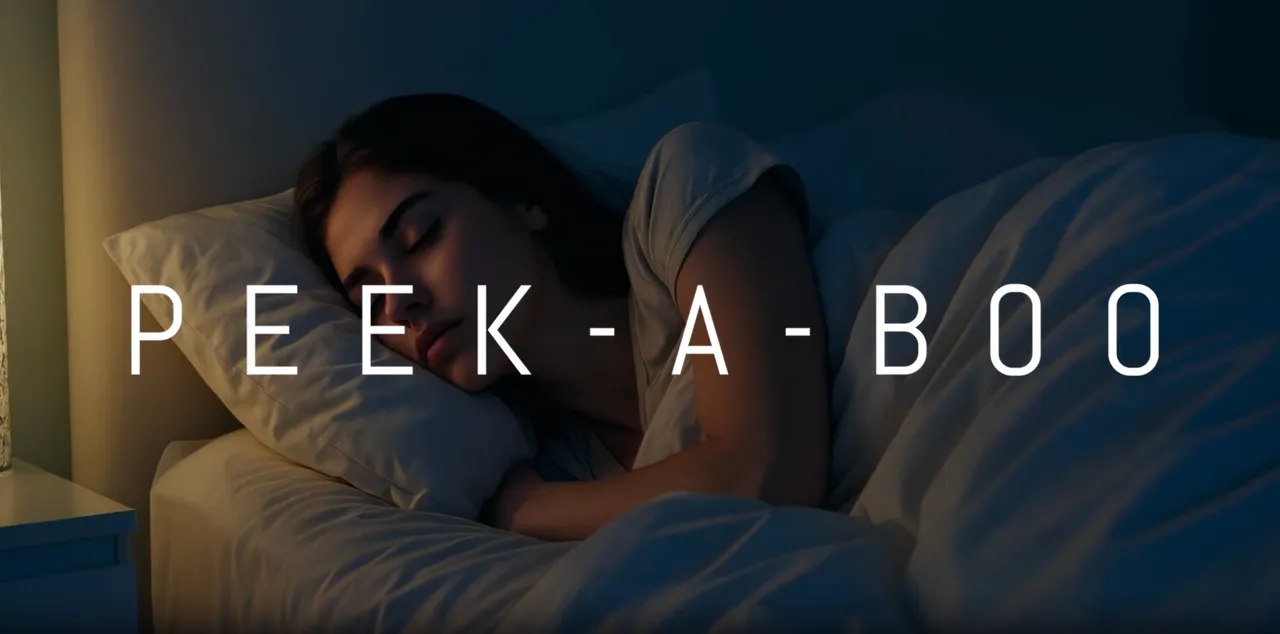
A midnight horror where silence becomes the loudest scream.
Fear has a rhythm. It creeps, pauses, and waits—just long enough for you to believe you’re safe. Then it moves again. That pulse defines AI Beyond Frames’ PEEK-A-BOO, a masterclass in psychological horror that transforms a single bedroom into a battleground between consciousness and terror.
Set on a storm-lashed night that feels suspended between dream and delirium, PEEK-A-BOO follows Lisa, a young woman unable to sleep as something unseen stirs in the darkness. The clock ticks to 3:15 A.M.—a time folklore often marks as the “Devil’s hour.” But this isn’t the story of possession. It’s something far more insidious: the horror of being alone with your own mind when it starts whispering back.
From the opening moments, AI Beyond Frames establishes tone with surgical precision. The rain outside doesn’t soothe—it isolates. Every flicker of lightning cuts the room into fragments of light and shadow. The ordinary becomes alien: curtains move when the window is closed, the hum of a charger morphs into a faint breath, and Lisa’s reflection seems to blink a beat too late. It’s a visual and auditory hallucination that builds not through jump scares, but through accumulated dread.
What makes PEEK-A-BOO so unnerving is its intimacy. The camera never leaves Lisa’s side. We see the world as she does—distorted, claustrophobic, trembling at the edges. The bed becomes both sanctuary and trap; the walls, both protection and prison. It’s horror distilled to its purest form: the moment before the scream.
AI Beyond Frames has crafted something remarkable here—an AI-assisted short film that feels handcrafted by fear itself. The use of generative visuals and neural light modeling gives the film a painterly texture that flickers between dreamlike beauty and suffocating unease. Shadows don’t just move; they evolve, reacting to Lisa’s breathing, as though her anxiety is summoning them into existence. The effect is disorienting and hypnotic, perfectly capturing the sensation of insomnia bleeding into nightmare.
At its thematic core, PEEK-A-BOO is not just about fear—it’s about vulnerability. Lisa isn’t hunted by a monster; she’s haunted by possibility. The idea that the boundary between safety and threat might no longer exist. The story plays like an internal haunting, where the mind itself becomes the ghost. AI Beyond Frames leans into this ambiguity, refusing to define what’s real or imagined. Every answer births another question, and by the end, the viewer is as trapped in uncertainty as Lisa herself.
The film’s sound design deserves special mention. Every creak, whisper, and static hum is meticulously engineered to manipulate spatial awareness. At times, the sound seems to move behind you, creating a surround illusion even in stereo playback. It’s a brilliant trick that turns the act of watching into participation—you become part of the haunted room.
What’s especially compelling about PEEK-A-BOO is how it uses AI filmmaking to expand the emotional vocabulary of horror. Rather than relying on photorealism or shock, AI Beyond Frames explores the uncanny—how artificial images can mimic our subconscious fears. Faces blur just slightly wrong, motion stutters in a way too smooth to be human, and the line between film and fever dream vanishes. The result isn’t just eerie—it’s uncannily personal.
Within the Get Abyss creative community, PEEK-A-BOO stands as one of the most innovative experiments in AI-driven cinema. It demonstrates how horror doesn’t need gore or spectacle—it needs atmosphere, empathy, and rhythm. The series’ minimalist design invites other creators to remix or expand upon it, transforming a short, contained nightmare into a shared creative mythos.
The final moments of PEEK-A-BOO are unforgettable. Lisa lies still, eyes wide, as the storm quiets outside. For a fleeting second, silence feels safe again. Then something whispers her name—not behind her, not in the room, but inside. The screen cuts to black.
It’s in that void—between breath and scream, light and dark—that PEEK-A-BOO truly lives. AI Beyond Frames has not only created a film but captured a feeling: that fragile, electric moment when you realize the thing you’re afraid of was never out there at all.