
Ezra’s TOMO
The Price of Forgetting in a Neon World
October 31, 2025
Article
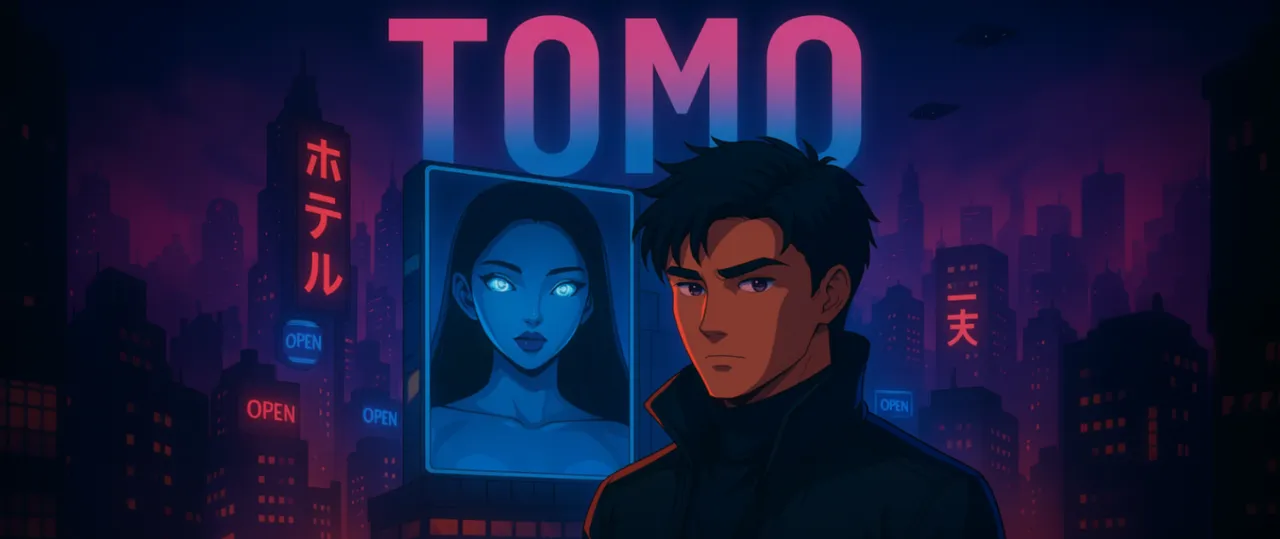
In a future that sells amnesia by the minute, one man begins to remember.
In the rain-soaked alleys of a neon metropolis, memory is no longer sacred—it’s a product. In Ezra’s TOMO, the human mind has become the final marketplace, where pain, grief, and love can be erased for a price. But what happens when the one doing the erasing starts to remember? This haunting, emotionally charged sci-fi noir follows Tomo, a quiet memory extractor who makes his living deleting people’s darkest moments—until a job gone wrong forces him to confront the one memory he was never supposed to see: his own.
The story opens in “The First Memory,” an 8-minute pilot that feels like stepping into a dream you’ve already forgotten. Tomo drifts through a city suspended in artificial twilight, its skyline humming with digital billboards and surveillance drones. The tone is unmistakably noir: melancholic voiceovers, cigarette smoke curling against holographic light, and a sense of loneliness that hums beneath every word. When we first meet Tomo, he’s performing a delicate extraction for a grieving mother—removing the memory of her child’s final breath. It’s work that demands precision and detachment, two qualities Tomo has perfected. But beneath his calm exterior lies a hollowness he can’t explain.
Ezra’s storytelling blends classic cyberpunk themes with an emotional intimacy rarely seen in the genre. The world of TOMO isn’t just a dystopia—it’s a reflection of our own age of data saturation and emotional outsourcing. Memory has become the ultimate form of currency, and those who control it, control reality itself. Tomo’s employer—a faceless corporation known only as Mnemosyne—runs this trade like a religion, promising peace through oblivion. Yet, as the story unfolds, we learn that erasure always leaves residue, and the cost of forgetting may be greater than the pain of remembering.
After a seemingly routine assignment, Tomo is ambushed and injected with an unknown memory—a fragment from his own childhood. For the first time, he feels something real: confusion, nostalgia, fear. The image of his missing mother flashes before him, along with a phrase that replays in his mind like broken code. The moment marks the beginning of his unraveling. What follows is a descent through the underbelly of the city—abandoned data vaults, black-market clinics, and neural archives where the dead still whisper. Each recovered memory reveals a piece of a larger conspiracy: one that connects Tomo’s erased past to the origins of Mnemosyne itself.
Visually, TOMO is stunning. Ezra’s direction merges the painterly atmosphere of Ghost in the Shell with the emotional restraint of Blade Runner 2049. The lighting alone tells a story: cool blues and sickly yellows mirror Tomo’s dual existence—half human, half ghost. The city isn’t just a backdrop; it’s a character, pulsing with life and indifference. Every raindrop feels alive, every reflection a metaphor for identity fractured and refracted.
What elevates TOMO beyond genre tropes is its emotional depth. Beneath the dystopian architecture lies a story about grief, guilt, and the longing for connection in an age of mechanical intimacy. Ezra’s writing doesn’t shy away from silence. The pauses between lines speak louder than the dialogue itself. Tomo’s struggle isn’t just against a system—it’s against the emptiness within him.
Within the Get Abyss community, TOMO has been celebrated as a benchmark of AI-driven cinematic storytelling. Ezra’s use of generative visuals and voice synthesis isn’t gimmick—it’s worldbuilding. The imperfections in the AI renderings echo the fragmented nature of memory itself, creating a visual language that feels both alien and achingly familiar. It’s a perfect example of how creators on Abyss are redefining narrative form—using technology not to escape humanity, but to rediscover it.
By the end of “The First Memory,” Tomo wakes in the same city, but everything has changed. His mission is no longer to extract memories, but to reclaim his own. In a world built on forgetting, remembrance becomes rebellion.
Ezra’s TOMO is noir for a new generation—a story about identity, loss, and the unbearable beauty of things we can’t erase. It lingers like an afterimage, a whisper reminding us that memory, no matter how painful, is what makes us human.