

9 Episodes
outofnowhere
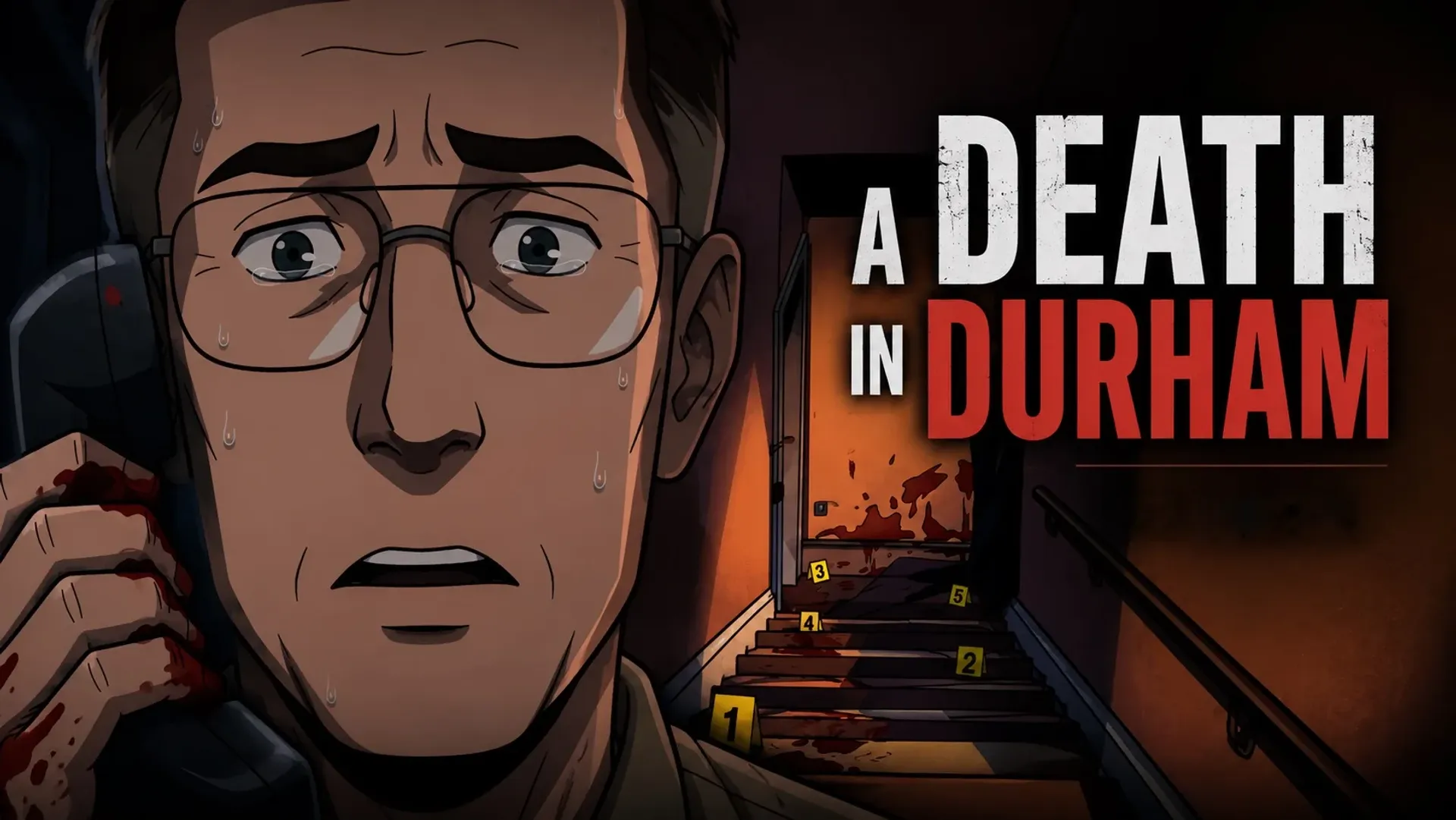
A nine-episode narrator-driven true-crime series on the death of Kathleen Peterson — found at 2:43 a.m. at the bottom of a back staircase in an upscale Durham, North Carolina home, her novelist husband Michael covered in blood and calling it a fall. The series follows the homicide ruling, the unraveling of Michael's invented war-hero past, and the secret double life prosecutors built into a motive — then a second woman found dead at the foot of a staircase sixteen years earlier. It tracks the guilty verdict, the discredited blood analyst who tore the case back open, a neighbor's owl theory the town turned into a punchline, and an Alford plea that set Michael free without ever answering the question. Two women. Two staircases. One man in the house both nights.
9 Episodes

36 sec.
At 2:43 in the morning, Michael Peterson, 58, calls 911 to say his wife fell down the stairs and is still breathing. He's a novelist; she's a telecom executive — a happy second marriage and a blended family of five raised under one roof. Earlier they'd been drinking wine by the pool; by his account she went in to bed and he stayed out, then found her at the bottom of the back staircase. Blood pooled across the steps, streaked up the walls. The officers had seen people fall down stairs before. It had never looked like this.

23 sec.
By the time police arrive, some of the blood has already dried. Michael is covered in it — hands, shirt, shorts — and an officer stops his hand when he reaches to wash it off. Within hours the stairwell isn't the site of a fall; it's a crime scene, numbered evidence tents beside every drop. Medical examiner Dr. Deborah Radisch counts seven deep gashes across the back of Kathleen's scalp. A fall can't explain them, she rules. Homicide.

32 sec.
Eleven days after the 911 call, the man who reported his wife's fall is charged with her murder. To understand the case, you had to understand who he'd told everyone he was — a celebrated novelist, a decorated Marine, a war hero who'd bled for his country. Then people checked the record: the medals, the combat wounds. They weren't real — his injuries hadn't come from battle at all. The war hero had invented the war hero, and investigators wanted to know what else he was hiding.

36 sec.
They started with his computer — deleted, then recovered: emails to a male escort and hundreds of images he'd kept hidden. The prosecution built a motive around it: a double life, a wife who found out, and a life insurance policy worth $1.5 million. Their story — Kathleen discovered the secret, a fight erupted, and it ended at the bottom of the stairs. But the escort testified they'd never even met, and that Michael spoke only warmly of his wife. There was no proof Kathleen ever knew. All the prosecution had was a story.

48 sec.
Then a break came — sixteen years earlier. Elizabeth Ratliff, a widow and close friend, was found dead at the bottom of her stairs in Germany in 1985; the last person to see her alive was Michael, who took in her two orphaned girls and raised them as his own. Her death was ruled natural — a brain hemorrhage. After Kathleen died the same way, someone remembered. Eighteen years on, prosecutors exhumed Ratliff's body as the daughters Michael raised watched their mother come out of the ground — and a second autopsy found wounds a fall couldn't explain. Two women, two staircases, and for the first, no one had ever been charged.

40 sec.
At trial, blood-spatter analyst Duane Deaver tells the jury the blood on the walls and on Michael's clothes is consistent with a beating, not a fall — the prosecution now had more than a story; they had science. They claimed the weapon was a fireplace blow poke, but it was never found — until the defense pulled it from the garage, cobwebbed and undamaged. A family split down the middle watched: the children who believed him, the sister who never would. After three months, the jury returned a verdict — guilty, first-degree murder, life without parole. And just like that, it seemed to be over.

52 sec.
In 2010, Greg Taylor walked free after seventeen years for a murder he didn't commit — and the blood analyst who'd helped convict him was the same one who testified against Peterson: Duane Deaver. An investigation tore open the state crime lab and found he'd misrepresented blood evidence in dozens of cases. He was fired. A judge ruled Deaver had misled Peterson's jury, and the science that convicted him was no longer evidence at all. The conviction was thrown out, and after eight years the man sentenced to die in prison walked out the front gate — free, but free wasn't the same as innocent.

58 sec.
The seven narrow, sharp cuts on Kathleen's scalp were never the dents of a club — and one man thought he knew what made them: the talons of a barred owl. Larry Pollard, an attorney next door, papered his study with autopsy diagrams; the owls nested in the woods all around the house. His theory — an owl struck her outside in the dark, and she ran for the house bleeding and collapsed on the stairs. In her own hand, clutched: her hair, a pine needle, and a microscopic sliver of feather. People laughed; it became the punchline of the whole case. But no court ever tested it — so no one ever ruled it out either.

49 sec.
With a new trial finally within reach, Michael Peterson made an unusual choice: an Alford plea — a guilty plea and a denial of guilt in the same breath. He admitted the state had enough to convict and insisted he was innocent. The sentence was the time he'd already served: no more prison, no verdict, no answer. He walked out a free man and a convicted one, both at once. The daughters he raised still call him Dad; Kathleen's family still call him a murderer. A jury said guilty, a judge threw it out, a neighbor blamed an owl — and to this day, no one can tell you for certain what happened.